
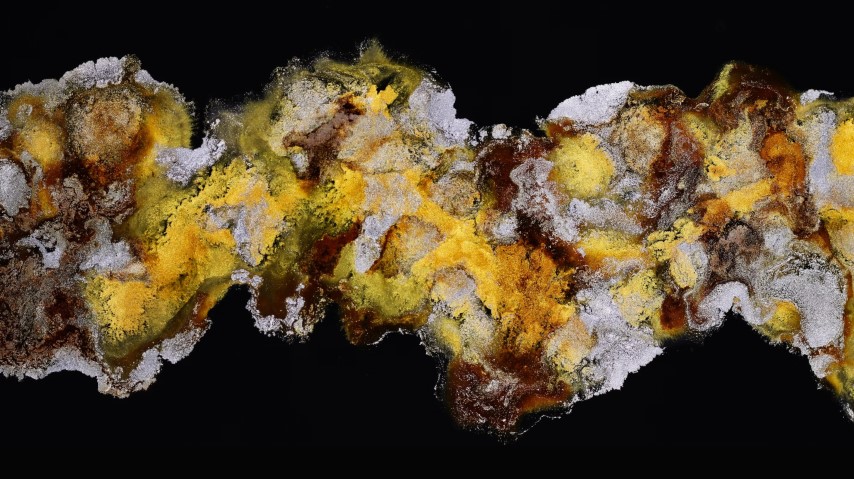
There’s a particular kind of contemporary painting that doesn’t ask you to “get the message” so much as it asks you to stay with the feeling. Miranda Moll’s work lives in that space—where observation turns poetic, where scientific literacy doesn’t flatten mystery, and where the natural world is approached with both rigor and reverence. Based in Calgary, Moll paints and draws as if she’s tracing the invisible filaments between things: body and biosphere, emotion and ecology, the cellular and the cosmic.
What makes her practice so compelling is how naturally her two worlds—science and art—interlock. She doesn’t treat biology as a theme to illustrate, or climate change as a topic to “cover.” Instead, her paintings become a place where wonder and inquiry can coexist, and where viewers are invited to contemplate life’s strangeness without being cornered into a conclusion. Visual Art Journal
From ecosystem health to the studio
Moll’s academic background is substantial: a Bachelor of Science (Honours) in Biology, a Master of Science focused on Biodiversity, Wildlife and Ecosystem Health, and ongoing doctoral studies in Geoscience and Biological Sciences.
But what’s striking is how she describes the origins of that trajectory—not as a career move, but as a lifelong magnetism. She recalls childhood days spent outdoors, searching for “creepy crawlies,” wanting to be immersed in wild places. That early attachment to the living world later deepened into a scientific realization: the more she learned, the harder it became to believe in clean boundaries between “self” and “environment.”
She points to the intimate realities of biology—like the trillions of microorganisms that support our survival—and the constant exchange of matter between our bodies and the world around us. In her view, science doesn’t reduce that connection; it validates it.
Wonder as a method (and a philosophy)
Moll’s “about” page opens with a line that feels like a thesis statement: she paints “at the meeting place of science and wonder.” It’s an important pairing—because in her work, wonder isn’t sentimental. It’s a way of perceiving that stays alert to pattern, process, and the quiet choreography of living systems. Miranda Moll Art
In her Visual Art Journal interview, she expands on this by questioning how humans categorize nature and how those constructs shift with each scientific advancement. There’s humility in that perspective: an awareness that there’s “a whole world we do not understand” simply because we can’t yet measure or observe it.
That uncertainty is not a void in her practice—it’s a generator. Moll describes moments in nature where true presence sparks a kind of awe: seeing a tree or insect and being struck by the strangeness of two beings occupying the same moment from different evolutionary paths. She wonders about consciousness, about experience, about where we draw lines that may not actually exist. Her art becomes a space where those questions can breathe.
Eyes, seeing, and being seen
One of the most recognizable motifs in Moll’s work is the eye. It’s a symbol that can easily become decorative or overly literal in lesser hands—but for Moll, it’s charged with psychological and social meaning. She describes eyes as representing “seeing and being seen,” and even the desire for understanding—or to be understood. Importantly, she keeps the symbol fluid: its meaning can shift depending on the context of the painting.
She also notes how eyes carry an unusual intensity because they can hold vivid emotional expression. As a social species, we’re wired—genetically and culturally—to read faces for information. Add in religious and symbolic histories of the eye, and you get an image that arrives already layered with subconscious associations. Moll doesn’t shy away from those preconceptions; she uses them to create a “diversity of messages,” making the motif a versatile tool for exploring emotion, perception, and connection.
In that sense, the eye becomes more than a visual signature. It becomes a bridge between inner and outer worlds: biology (how we perceive), psychology (how we interpret), and art (how we feel what we see).
A transparent palette that keeps the world luminous
Colour is another defining force in Moll’s practice—and she speaks about it with the specificity of someone who understands systems. She loves vibrancy, and she deliberately builds it through a limited palette of transparent colours. Rather than relying on a sprawling paint box, she works with two sets of each primary—magenta/red, cyan/blue, and yellow—each biased toward its neighbour on the colour wheel.
She gives a practical example: for blues, she often uses phthalo blue alongside yellows and ultramarine blue alongside magentas/reds. That choice isn’t just technical; it’s a strategy for keeping mixtures clean, saturated, and alive.
She’s also careful about what not to do. Moll tries to avoid mixing all three primaries (which tends to make brown) so her colours retain their intensity, and she treats white as something to add with intention because it can dramatically change texture and depth. Even her process stays dynamic—she mixes a fresh palette for each new painting to keep discovery at the center of making.
The result, as she describes it, can move from deep aquatic blues to vibrant cosmic tones—colour that feels less like a coating and more like atmosphere.
Climate and ecology—communicated without a lecture
Moll doesn’t hide from ecological grief. She speaks openly about climate anxiety: fear and sadness tied to the state of the planet, amplified by having witnessed extraordinary places and creatures and then watching that beauty “slip away.” She contrasts a childhood sense of wild places as “untouched” with the present reality of encountering carelessness and destruction as the norm.
And yet, the way this enters her paintings is nuanced. Sometimes it appears as a celebration of the natural world—rendered with wonder and admiration. Other times it comes through as heaviness: an acknowledgment of fragility and finiteness. The tone shifts depending on the piece and on her emotional state during its creation.
This is where Moll’s approach to communication becomes especially relevant. She has experience in science communication and environmental activism, but she’s frank about a hard truth: “reciting facts” is often ineffective for changing minds, and direct confrontation can make people more entrenched. Visual art, she suggests, has power precisely because it is silent. It doesn’t lecture—it invites. It creates space for internal contemplation, where a viewer can meet an idea without defensiveness.
In other words, her work doesn’t preach climate concern—it transmits ecological feeling. It lets the viewer arrive emotionally, then decide what to do with that arrival.
Follow Miranda Moll’s work
Miranda Moll’s paintings ask for a slower kind of attention—one that’s increasingly rare, and increasingly necessary. They honor science without turning it into a slogan, and they honor emotion without slipping into vagueness. If you’re drawn to contemporary work that holds wonder and urgency in the same hand—eyes wide open, colours luminous, questions intact—her practice is well worth following through her website and social channels. Miranda Moll Art
